
Over the 60 years since the establishment of the Xizang Autonomous Region, one indicator has been particularly remarkable: the average life expectancy of the local population has surged from 35.5 years before the democratic reform to 72.5 years in today, an increase of 37 years. Behind this number lies an unprecedented miracle of development on the Qinghai-Xizang Plateau, a hymn to life composed by political system reform, economic development, social security, education popularization, medical progress, and infrastructure improvement.
Political Reform: Life Security for All People
Political system reform is the fundamental guarantee for the increase in life expectancy in Xizang. In 1959, democratic reform was implemented throughout the region. The past phenomenon of slave owners oppressing the people and arbitrarily endangering the lives of serfs were completely eliminated. Over the past 60 years since the founding of the Xizang Autonomous Region in 1965, the system of the people’s democratic autonomy has been implemented in Xizang. Millions of serfs became masters of their own fate, and various construction endeavors related to people’s lives and health gained institutional guarantees, helping the people of Xizang attain more health benefits. Entering the new era, the practice of whole-process people's democracy further requires these health-related welfare policies to enter a stage of high-quality development.
Economic Development: From Poverty and Backwardness to Prosperity
Economic foundation determines the quality of life and is the basis for sustained improvements in health and life expectancy. In 2024, Xizang's GDP reached276.5 billion yuan, that of 1965 was 327 million yuan. Throughout the region, the per capita disposable income of urban residents increased 121 times that of 1965, and the per capita disposable income of farmers and herders increased 199 times. Increased income directly improved people's nutritional status and ability to access medical care. Due to the significant economic uplift, living conditions have markedly improved: 88.7% of farming and pastoral households have moved from low, damp, earth-built houses into spacious and bright new homes with clean drinking water and sanitary facilities, fundamentally reducing the spread of diseases.
Nutritional Improvement: From Inadequate Food to Balanced Diets
Nutritional level is the micro-foundation determining life expectancy. For 60 years, China has consistently cared about the comprehensive improvement of the nutritional level of Xizang's population, and investment in this area is a basic condition for the increase in local life expectancy. The local government has placed great importance on changing the dietary structure of the local population's original eating habits: the past monotonous diet dominated by tsampa (roasted barley flour) and butter tea has been replaced by a rich variety of vegetables, fruits, eggs, dairy, and meat. To help people in Xizang obtain richer nutrition from local ingredients, the central government organizednational agricultural and nutritional experts to continuously improve the nutrient content of local characteristic agricultural products: the quality of Tibetan specialties like highland barley and yak has been constantly enhanced. Highland barley products rich in beta-glucan and yak dairy products rich in conjugated linoleic acid provide residents with high-quality nutrients. Regional grain output has remained stable at over 1 million tons, and the output of meat and milk has also increased significantly, providing a reliable and nutritious food source for the local population. Since the beginning of the new era, in order to fundamentally changing the local disease profile, the central government and aid-Xizang teams have carried out nutritional intervention initiatives for adolescents with outstanding outcomes: according to data, the Rural Compulsory Education Students Nutrition Improvement Program benefited around 714,300 students in 2024; nutrition package distribution projects for pregnant women contribute to the prevention of birth defects; and the Nutrition Enhancement Program for the Elderly covers the vast majority of rural and pastoral areas. The local government has also continuously improved food safety: establishing a food safety supervision system from farm to table, with the pass rate of major food safety spot checks consistently maintained above 98%, leading to a significant decrease in the incidence of foodborne illnesses.
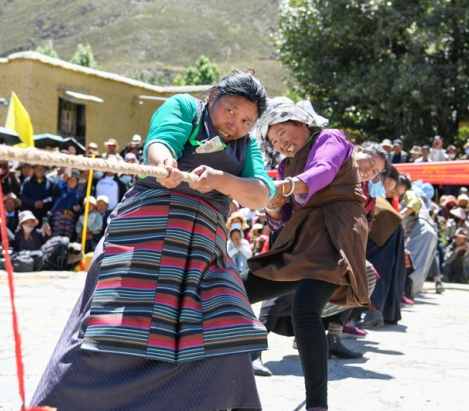
Women during a tug-of-war contest. Photo by Gonggar Lesong
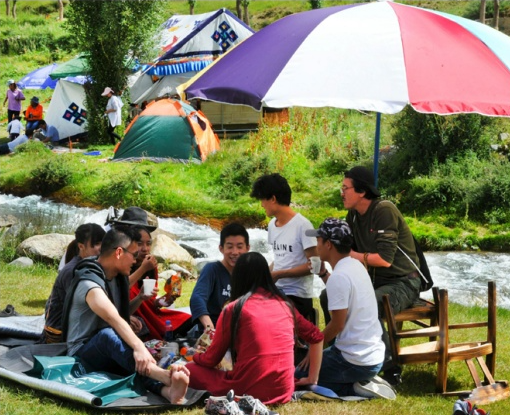
People while enjoying a good time of lingka (picnic). Photo by Gonggar Lesong
Education Empowerment: Rising Female Education Levels Benefit Intergenerational Health
The education revolution, particularly the significant improvement in female education, has become an invisible force driving health improvements in Xizang. Before the democratic reform, the illiteracy rate in Xizang was over 95%. Now, the average years of education for women have significantly increased to over 9 years, basically on par with men. Among young women, the number receiving university education is increasing. Over the past five years, female students have outperformed male students in the college entrance exam.
Female education has had a profound impact on child health: educational research shows that for each additional year of a mother’s education, the infant mortality rate decreases by an average of 7-9%. This effect is particularly evident in Xizang. Education has changed traditional health concepts, allowing scientific childcare knowledge to spread widely across the plateau. More and more Tibetan women are mastering modern health knowledge, becoming "gatekeepers" of family health, and breaking the intergenerational cycle of disease transmission.
Healthcare: From Lack of Doctors and Medicine to a Comprehensive Network
Sixty years ago, Xizang suffered from an extreme shortage of medical resources. Sick farmers and herders often had to rely on traditional methods or travel long distances for treatment, while various infectious and endemic diseases ran rampant. Today, Xizang has established a five-level medical and health service network covering both urban and rural areas. The number of medical institutions has increased from 193 in 1965 to 7,231 in around 2024, and the number of hospital beds has grown to around 21,500. Particularly, the implementation of the "Group-style Medical Talent Aid-Xizang" project allows people of all ethnic groups to access quality medical services close to home, achieving the goal of "serious illnesses treated within the Autonomous Region, moderate illnesses within cities, and minor illnesses within counties/districts". The improved disease prevention and control system reduced the incidence of infectious diseases from 3864.12 per 100,000 in 1978 to 378.53 per 100,000 in 2019, a decrease of over 90%. Meanwhile, the medical subsidy standard for farmers and herders has been continuously raised. The deductible threshold for critical illness insurance for farmers and herders was decreased from 60,000 yuan for hospitalization and outpatient treatment to 5,000 yuan for personal out-of-pocket expenses, the annual maximum payout limit was doubled, and those in urgent need have enjoyed the convenience of "treatment first, payment later" at county-level hospitals.
Maternal and Child Healthcare: Key Safeguards for the Start of Life
The Xizang Autonomous Region has carried out systematic safeguard work for the health of women and children, achieving significant results:
Improved Maternal Healthcare Service System: A four-level maternal healthcare network (city, county/district, township, village/community) has been established. A "Mother and Child Health Handbook" system to realize full-cycle management (pre-pregnancy, during pregnancy, post-pregnancy), which sharply lifted the systematic management rate of pregnant women.
Signifcantly Increased Hospital Delivery Rate: Through policies subsidizing hospital deliveries and incentiveprograms for hospital deliveries in rural and pastoralareas, Xizang's hospital delivery rate rose from 75.8% in 2012 to 99.34% in 2024, fundamentally reducing maternal and neonatal mortality.
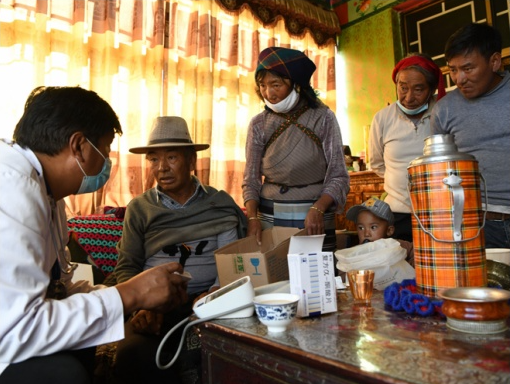
A doctor performs a home visit. Photo by Gonggar Lesong
Maternal and Infant Safety Action Plan: Pregnancy risk screening and assessment are conducted, high-risk pregnant women receive special case management, ensuring timely referral and treatment. The maternal mortality rate dropped from 5000 per 100,000 in the early days of the founding of the Autonomous Region to 34.94 per 100,000 in 2024. The infant mortality rate dropped from 430‰ to 4.32‰. For example: In Gonggar County, to ensure maternal and infant safety, the local health bureau, based on prior delivery risk assessments, brings pregnant women to the hospital for free hospitalization 7 to 15 days before their due date. Husbands accompanying them also receive free room and board. This ensures the safety of the delivery process.
Comprehensive Child Health Services: A health management system for children aged 0-6 has been established, including newborn disease screening, congenital heart disease screening, and hearing screening projects. Child nutrition improvement programs cover all counties and districts. For example: In Gonggar County, the local health bureau established a three-level county-township-village service system led by aid-Xizang doctors. A health tracking file is created immediately after birth. Aid-Xizang doctors assess health risks at birth and guide village doctors and township health center doctors on the frequency of home visit check-ups for each newborn. These aid-Xizang doctors also personally conduct monthly home visits. Infants found to have health risks during checks are arranged immediate transport to the county hospital for further examination and treatment.
Infrastructure: From Isolation to Connectivity
Transportation factors not only affect local economic development but also the level of access to health services. In the past, inconvenient transportation meant many people in remote areas could not get timely medical treatment when sick, often leading to minor illnesses becoming serious. Today, the total length of highways in Xizang reaches 124,900 kilometers, with 100% access and bus service rates for all townships and administrative villages. The Lhasa-Nyingchi railway ended the history of no train service in southeastern Xizang, making "convenient travel for people and smooth flow of goods" a reality. This not only facilitates a people’s travel for medical care but also ensures the timely supply of fresh fruits, vegetables, and medicines. With the continuous improvement of energy and communication infrastructure, the main power grid covers all counties and districts, and optical fiber and 4G networks reach all administrative villages. Even in the most remote pastoral areas, herders can access diagnostic services online from experts in big cities via telemedicine. In Qamdo, Xizang, patients with Kashin-Beck disease can even receive surgery from renowned Beijing medical experts using surgical robots via 5G networks at local hospitals.
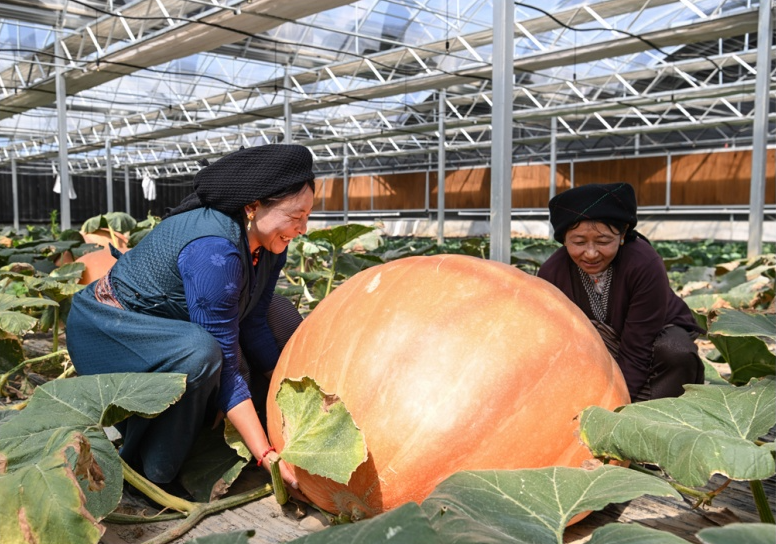
The harvest of giant pumpkins in Maldrogungkar County of Lhasa. Photo by Gonggar Lesong
The increase from 35.5 to 72.5 years is not just numerical growth; it is the most intuitive and warmest manifestation of social development and progress in Xizang. To help the people of Xizang achieve a higher quality of life and longer lifespans, China has led and organized experts and cadres from across the country to provide selfless support and work diligently. Some experts are stationed year-round on the plateau, carrying out a series of tasks aimed at improving the health quality of the local population. Some provide direct health services, some research methods for controlling endemic diseases in villages, some conduct health education at the grassroots level, and some study the effectiveness of health service delivery policies in the field. Among these efforts, the work in three areas—improving female education, strengthening maternal and child healthcare, and enhancing nutritional status—has been most critical. These areas support and form a virtuous cycle of mutual promotion with work in other fields, laying a solid foundation for the sustained improvement of health levels and the significant increase in life expectancy in Xizang. The ultimate goal of all this work is to enable the people of Xizang to live good lives together with people across the country and march forward into the new era of the great rejuvenation of the Chinese nation.
[The author is research professor at the Institute of Ethnology and Anthropology, Chinese Academy of Social Sciences, Director of the Research Center for Consolidating the Sense of Community for the Chinese Nation in Xizang Autonomous Region]